
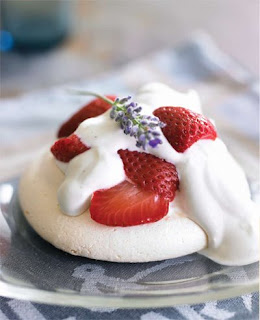
 From The Art and Soul of Baking
Makes 8 Pavlovas
Pavlova, the favorite dessert of Australia and New Zealand, consists of a meringue shell that is crispy on the outside and soft on the inside, cradling a filling of whipped cream and fruit. It was named in honor of the Russian ballerina Anna Pavlova, famous at the time for her beautiful dancing. Apparently the dessert was as light and lovely as Anna herself, who toured New Zealand in the late 1920s and Australia in the mid 1930s. This version features poached strawberries and whipped cream sweetened with lavender sugar, an easy-to-make combination of granulated sugar and dried lavender ground to a fine powder. You might wonder why anyone would bother to poach strawberries, since they are so delicate in their fresh state. The heat from the poaching syrup softens their flesh, making them meltingly tender so they practically dissolve in your mouth. The poached berries meld beautifully into the soft cream and marshmallow-like meringue in this very special dessert.
Ingredients
Meringue
2/3 cup (4 3/4 ounces) sugar
1 tablespoon cornstarch
3 large egg whites
¼ teaspoon cream of tartar
Pinch of salt
¼ teaspoon pure vanilla extract
Strawberries
3 pint baskets (about 3 pounds) fresh strawberries
2 cups (16 ounces) water
1 ¼ cups (8 ¾ ounces) sugar
Honey-Lavender Cream
2 tablespoons (1 ounce) sugar
1 tablespoon dried lavender blossoms or
2 tablespoons fresh lavender blossoms
1 ½ cups (12 ounces) heavy whipping cream
1 ½ tablespoons mild-flavored honey, such as orange blossom
Fresh lavender, for garnish
Equipment
Fine-Mesh Strainer, Small Bowl, Stand Mixer Fitted with a Whisk Attachment or a Hand Mixer and a Medium Bowl, Silicone or Rubber Spatula, 12 by 17-inch Baking Sheet, Parchment Paper or Silicone Mat, ¹⁄³-cup Dry Measuring Cup, Cooling Rack, Strawberry Huller or Paring Knife, Medium Saucepan, Spice or Coffee Grinder, Slotted Spoon
1 Make the meringues: Preheat the oven to 250°F and position an oven rack in the center. Use the fine-mesh strainer to sift 2 tablespoons of the sugar and all the cornstarch into the small bowl. Place the egg whites, cream of tartar, and salt in the bowl of the stand mixer and whip on medium-high speed for 1½ to 2 minutes, until soft peaks form. You can also use a hand mixer and a medium bowl, although you may need to beat the mixture a little longer at each step to achieve the same results. Add the vanilla and, with the mixer running, slowly rain in the remaining sugar. Turn the speed to high and whip until the meringue is very stiff, 30 to 45 seconds. Sift the sugar-cornstarch mixture over the meringue and gently fold it in with the spatula just until blended.
2 Line the baking sheet with parchment paper or a silicone mat. Gently spoon meringue into the ¹⁄³-cup measuring cup, level the top, and use the spoon to help turn it out onto the baking sheet. Create 7 more portions in this manner, spacing them evenly. Use the back of the spoon to make a well in each meringue. The finished meringues should be about 3 inches wide and 1 inch tall.
3 Bake the meringues for 50 to 55 minutes, until faintly golden and crispy on the outside. The interior will still be soft and fluffy. Transfer to a rack and cool completely.
4 Poach the strawberries: Wash the berries and pat dry. Hull each berry using a strawberry huller or the tip of a paring knife. If the strawberries are large, cut them into quarters or ¼-inch thick slices. Place the water and sugar in the medium saucepan and bring to a boil. Simmer for 1 to 2 minutes, until the sugar is completely dissolved. Carefully transfer the berries to the syrup and bring back to a simmer. As soon as the syrup begins to boil again, remove from the heat and cover the pot. Let the berries sit in the syrup until the mixture is room temperature, about 30 minutes—they will poach in the residual heat.
5 Make the honey-lavender cream: Place the sugar and lavender in the spice or coffee grinder and grind until the texture is very fine. Transfer to the small bowl. Place the cream, honey, and 1 ½ tablespoons of the lavender sugar in the cleaned bowl of the stand mixer and whip until the cream holds soft peaks (save the remaining lavender sugar for another use). You may also use the cleaned hand mixer and medium bowl here. Cover with plastic wrap and refrigerate for 30 minutes to allow the flavors to blend.
6 Assemble the Pavlovas: Use the slotted spoon to scoop the strawberries from the poaching liquid and drain slightly on paper towels. (Save the poaching syrup for flavoring sparkling water or use it for a refreshing twist in your favorite cocktail.) Place a meringue on each serving plate. Fill the center of each meringue with honey lavender cream and top with 4 or 5 strawberries. Garnish with some fresh lavender and serve immediately.
What the Pros Know
Be sure you purchase dried lavender from a culinary source such as the bulk department of a health food store or a specialty herb supplier, so you can be sure the flowers were not treated with harmful chemicals. Flowers grown for commercial and potpourri use are laden with pesticides and should never be used in cooking or baking.
Getting Ahead
The meringues can be baked up to 3 days in advance and stored in an airtight container at room temperature. The strawberries can be poached up to 2 days in advance and refrigerated in the poaching syrup. The lavender sugar can be prepared up to 1 month in advance and stored airtight at room temperature. The honey-lavender cream can be prepared up to 3 hours in advance and chilled in an airtight container.
Wednesday, March 31, 2010
Pavlovas with Honey-Lavender Cream and Poached Strawberries

Thursday, March 25, 2010
Panko-Crusted Chicken Cutlets with Arugula Salad
 From Things Cooks Love: Implements. Ingredients. Recipes.
Prep 25 min | cook time 10 min | serves 4
Panko, sold in Asian groceries and in many supermarkets, develops a golden, crunchy crust when fried that stays crisp. Here, the panko are tossed with grated Parmigiano Reggiano cheese to give them an Italian profile and extra flavor.
Implements
Paring or Utility Knife, Meat Pounder, Spiral or Small Whisk, Medium Shallow Bowl, Shallow Baking Dish, Large Rectangular Wire Rack, Rimmed Sheet Pan, 10- to 12-inch Skillet, Tongs, Medium Bowl
Ingredients
4 (4- to 5-ounce) boneless, skinless chicken breast halves
Coarse salt
Freshly ground black pepper
4 paper-thin slices prosciutto
1 large egg
¼ cup milk
1 ¼ cups panko
¹⁄3 cup grated Parmigiano-Reggiano
Canola or other flavorless vegetable oil, for frying
Arugula Salad
1 tablespoon red wine vinegar
½ clove garlic, grated or minced
½ teaspoon coarse salt
2 tablespoons extra-virgin olive oil
2 tomatoes, cut into thin wedges
2 cups packed arugula or baby spinach leaves, rinsed and dried
1. Trim any bits of tendon or fat from the chicken. Make sure the fillet, or tenderloin, attached to the underside of each breast has been removed. If it hasn’t, gently pull it away from the breast and reserve for another recipe.
2. Cut 2 sheets of plastic wrap each about 10 inches long. Place a chicken breast on 1 sheet and cover with the second sheet. Gently pound the chicken until evenly flattened to between ¼ and ¹⁄3 inch thick. Repeat with the remaining breasts. When all of the breasts have been pounded into cutlets, sprinkle them lightly on both sides with salt and pepper. Pat a slice of prosciutto on top of each cutlet and trim any excess.
3. Whisk the egg in a shallow bowl and then whisk in the milk. Combine the panko and grated cheese in a shallow baking dish and stir to mix. Dip the chicken in the egg and let the excess drip back into the bowl. Lay the chicken on the panko mixture, turn to coat, and press the crumbs into the chicken with your fingertips.
4. Place a rectangular wire rack on a rimmed sheet pan. Heat a heavy 10- to 12-inch skillet over medium-low heat. Pour in vegetable oil to a depth of about ½ inch and heat until hot. To test the heat of the oil, add a pinch of panko. It should sizzle and turn golden brown on contact. When the oil is ready, add the chicken 1 or 2 pieces at a time, depending on the size of the skillet. Cook, turning once, for 2 minutes per side, or until the panko turns a deep gold. Use tongs to lift the chicken from the oil and place on the wire rack.
5. meanwhile, make the salad: In a medium bowl, whisk together the vinegar, garlic, and salt. Slowly whisk in the olive oil in a slow, steady stream. Add the tomatoes and arugula and toss to coat evenly.
6. Place a chicken cutlet in the center of each dinner plate. Distribute the salad evenly on top of the cutlets. Serve at once.
Monday, March 15, 2010
White Chocolate–Lime Crème Caramel
 From The Art and Soul of Baking
Serves 6
Whether you call it flan, crème caramel, or crème renversée, it’s hard to resist a creamy custard turned upside down and served in a pool of liquid caramel. The flavors of crème caramel are always more complex than regular custard because of the caramel that surrounds it during baking and chilling, which adds a layer of flavor beyond the custard itself. A measure of white chocolate gives this one a lovely texture, while the lime and caramel work in tandem to cut the sweetness of the chocolate. Though this is a classic crème caramel, with whole milk and eggs only, the white chocolate makes it taste richer and creamier.
Ingredients
Custard
2 cups (16 ounces) whole milk
3 tablespoons (1 ½ ounces) sugar
Grated zest of 3 limes
3 large eggs
6 ounces white chocolate, finely chopped
Caramel Lining
½ cup (4 ounces) water
1 cup (7 ounces) sugar
¼ teaspoon cream of tartar
Candied lime zest (page 352) and Softly
Whipped Cream (page 416), for serving
Equipment
Medium Saucepan, Small Saucepan, Six (6-Ounce) Ceramic Ramekins or Custard Cups, Small Bowl (Optional), Large Roasting or Baking Pan, Whisk, Medium Bowl, Fine-Mesh Strainer, Pitcher or Large Measuring Cup with Spout, Tongs, Cooling Rack, Mini-Spatula
1 Make and flavor the custard: Heat the milk, sugar, and lime zest in the medium saucepan over low heat just until the mixture begins to simmer. Remove from the heat, cover, and allow to steep for 1 to 1½ hours, until the lime flavor is strong. You can even leave the mixture to steep overnight in the refrigerator, if you like.
2 Make the caramel lining: Pour the water into the small saucepan and add the sugar and cream of tartar. Cook over medium heat, stirring constantly, until the sugar has dissolved and the liquid is clear. Increase the heat to high and boil rapidly, swirling the pan occasionally (without stirring) to cook the sugar evenly, until the caramel turns a deep golden brown (for more on caramelizing sugar, see page 26). Remove from the heat and immediately divide the caramel among the custard cups, swirling each cup to distribute the still-liquid caramel evenly up the sides. Be careful to go only about halfway up the sides. The caramel is very hot and you don’t want it to drip off the edge of a cup and onto your skin. You may want to keep a small bowl of ice water nearby in case a bit of caramel touches your skin. Set the caramel-lined cups in the roasting pan, making sure they don’t touch, and let them cool for 10 minutes.
3 Preheat the oven to 325°F and position an oven rack in the center.
4 Temper the eggs: Place the saucepan with the lime-infused milk mixture back over medium heat, uncover, and reheat just until it begins to simmer. Whisk the eggs in the medium bowl. Twist a damp kitchen towel into a rope and wrap it around the bottom of the bowl to secure it while you temper the eggs. Pour about ½ cup of the hot milk mixture into the eggs, whisking constantly. Once blended, whisk in another ½ cup. Then slowly pour the rest of the mixture into the eggs, whisking constantly. Add the white chocolate and whisk until melted and blended completely.
5 Strain and bake the custard: Pour the mixture through the strainer into the pitcher and discard the zest. Divide the warm custard among the cups in the pan. Pull out the oven rack and place the pan on the rack. Remove one of the cups, pour enough hot tap water (not boiling) into that area to come halfway up the sides of the cups, and replace the cup. Cut a piece of foil large enough to fit just inside the edges of the roasting pan, then lay the foil across the top of the cups, making sure it doesn’t touch the custard. You may need to smooth and flatten the foil on the counter if any wrinkles touch the custard. Gently push the rack back into the oven, shut the oven door, and bake the custards for 30 to 40 minutes, until they are just set and their centers are no longer wobbly (test by gently tapping the side of the pan with a spoon).
6 Remove the foil and then the pan from the oven, being careful not to tilt the pan and splash water on top of the custards. Set the pan on a heatproof surface. Use a pair of tongs (or your hand protected by a kitchen towel) to immediately remove the cups from the water bath and place them on a rack to cool to room temperature, about 40 minutes. Cover with plastic wrap and refrigerate until cold, at least 4 hours or overnight.
7 Unmold the custards: Run a mini-spatula or a thin, flexible knife inside the edge of a cup, pressing the knife into the cup to avoid gouging the custard. Place a serving plate upside down on top of the cup, then, holding the two together, invert them. The custard should slide out of the cup and onto the plate. Candied lime zest is a lovely garnish here. Place a few strands on top of each custard and scatter a few more around each plate.
8 Serve the custards: Crème caramel is at its best at room temperature, so let the custards, still in their cups, sit out for about 30 minutes before serving. If you like, place a small spoonful of softly whipped cream on top of each. Candied lime zest is a lovely garnish here. Place a few strands on top of each custard and scatter a few more around each plate. To make candied citrus zest: Zest 4 limes, lemons, oranges, tangerines, or grapefruits using a vegetable peeler. Scrape off any white pith with the tip of a knife and cut the zest into long thin strips. In a small saucepan, bring 1 cup of water and 1 cup of sugar to a boil. Stir briefly until the sugar has dissolved and the liquid is clear. Add 2 tablespoons of light corn syrup and the zest. Reduce the liquid to a simmer, cover, and cook for 20 to 30 minutes, or until the zest is translucent and tender. Use immediately or refrigerate the candied zest in the syrup in an airtight container for up to 1 month.
White Chocolate–Lemon Crème Caramel Substitute the zest of 2 lemons for the lime zest.
White Chocolate–Orange Crème Caramel Substitute the zest of 1 large orange for the lime zest.
Getting Ahead
The caramel-lined cups can be prepared a day in advance and kept at room temperature, covered with plastic wrap. The custards can be baked up to 2 days in advance and chilled, covered with plastic wrap. Unmold shortly before serving.
what the pros know
Caramel is nearly impossible to scrub out of pans and dishes. The easiest solution for removing it from the saucepan is to fill the pan with water, bring it to a boil for 5 minutes (dissolving the caramel), and then discard the water. To clean custard cups, place them in a large pot, fill with water, and simmer for 10 minutes to dissolve the caramel. (If the caramel is particularly stubborn, you may need to do this twice.)
Tuesday, March 2, 2010
Spicy Steamed Mussels with Fennel and Tomatoes
 From Knives Cooks Love, by Sur La Table and Sarah Jay
This punchy rendition of mussels in white wine offers a quick course on several cuts: slicing, dicing, mincing, and chiffonading. Serve the mussels with crusty bread for dipping into the peppery tomato broth, or ladle the mussels and broth over hot linguine. When buying mussels, ask the fishmonger for a bag from the refrigerator in back, which are often fresher than those in the front display.
Serves 2 to 3 as a main course
1 small fennel bulb
1 small yellow onion
1 carrot
3 cloves garlic
2 small tomatoes
10 to 12 large fresh basil leaves
1 teaspoon black peppercorns
1/2 teaspoon fennel seeds
1/2 teaspoon kosher salt
1/8 teaspoon red pepper flakes
3 tablespoons extra-virgin olive oil
3/4 cup dry white wine
2 pounds mussels, scrubbed and debearded (discard any that do not close)
Trim the stalks from the fennel and cut a thin slice off the bottom; then core and cut the fennel into 1/4-inch crosswise slices (see page 119). Put the fennel into a large bowl. Cut the onion crosswise into ¼-inch semicircles (see page 95) and add to the bowl. Peel the carrot and cut into 1/4-inch dice (see page 109) and add to the bowl. Peel and mince the garlic (see page 100) and add to the bowl.
Core the tomatoes. Cut them in half through the equator and squeeze out the seeds. Cut them into ¼-inch dice (see page 127) and put them in a separate bowl. Cut the basil into chiffonade (see page 133) and reserve for the garnish.
Lightly crush the peppercorns and fennel seeds in a mortar and pestle. (Alternatively, put them in a small self-sealing plastic bag. Using the bottom of a cast-iron skillet, lightly crush them. Transfer the spices to a small dish.) Add the salt and red pepper flakes. Set aside.
Heat the oil in a heavy 6-quart or larger stockpot over medium heat. Add the fennel, onion, carrot, and garlic, and sauté, stirring occasionally, until softened but not browned, about 5 minutes. Stir in the spice mixture. Add the wine and the tomatoes along with any juices in the bowl. Bring to a boil.
Add the mussels to the stockpot (don’t stir), cover, and steam until the mussels open, about 5 minutes. Scoop the mussels into individual shallow bowls, discarding any that remain closed, and then spoon some vegetables and broth over them. Sprinkle each bowl with basil and serve immediately.
Fennel
Trimming, Coring, Slicing, and Dicing
If you’re braising or roasting fennel wedges, leave the core intact so it holds the fennel together. But for slicing or dicing, do cut away the core first. Lengthwise slices emphasize the vegetable’s tough and fibrous quality. Crosswise slices are more tender and juicy, and better for salads.
1 Cut off the stalks close to the bulb (save the fernlike fronds for a garnish, if you want). Trim off the hard base. If the outer layer isn’t too blemished or fibrous, leave it on. Otherwise, remove it and discard (or save for stock).
2 Cut the bulb into lengthwise quarters. Stand up one quarter on its base, or let it rest on the rounded side, and cut away the core. Repeat with the other three pieces.
3 Set the pieces on a flat side. Cut crosswise or lengthwise slices of the width you need. (For a dice, cut lengthwise slices and gather a few strips and cut across them.)
Tuesday, February 23, 2010
Couscous with Raisins, Golden Onions, and Butternut Squash
 From Things Cooks Love: Implements. Ingredients. Recipes.
Prep 30 min | Cook time (couscous) 1 hr 10 min | Cook time (stew) 50 min | Serves 6–8
Here, a simple vegetable stew of butternut squash and onions is spooned atop couscous flavored with cinnamon and dotted with raisins.
Implements
Wide 3-Quart Saucepan, 8-Quart Couscoussière, Dutch Oven
Ingredients
4 cups low-sodium vegetable or chicken broth
1 cinnamon stick
¼ cup raisins
1½ cups couscous
½ cup water
Coarse salt
3 tablespoons extra-virgin olive oil
2 large yellow onions, halved lengthwise and cut into vertical slices
1 (2 ½ to 3-pound) butternut squash, halved lengthwise, seeds and membranes removed, and
cut into ½ to ¾-inch cubes (about 8 cups)
2 teaspoons ras el hanout
¹⁄8 teaspoon cayenne
1 (14 ½-ounce) can diced tomatoes with juices
About 1 tablespoon all-purpose flour
2 tablespoons chopped fresh cilantro
2 tablespoons diced ¹⁄8-inch preserved lemon peel (page 328) or 1 large lemon, cut into 8 thin wedges, for garnish
Harissa, for serving
1. In a wide 3-quart saucepan or sauté pan, combine 2 cups of the broth, cinnamon stick, and raisins, and bring to a boil. Decrease the heat to low, cover, and simmer for 5 minutes. Add the couscous and stir to blend. Remove from the heat and let stand for 10 minutes. Uncover and cool for 10 minutes. Combine ½ cup of water and 1 teaspoon of salt in a small bowl and stir to dissolve. Sprinkle the salted water on the couscous while simultaneously raking it with your fingers to break up the lumps. Let stand, uncovered, until ready to finish cooking.
2. Add the oil to the bottom section of the couscoussière, a Dutch oven, or 5-quart sauté pan. Heat the olive oil over medium low heat until hot enough to sizzle a piece of onion. Add the onions and cook, stirring, over low heat, for 15 to 20 minutes, or until the onions are golden brown. Add the squash and cook, stirring, until coated with the oil. Sprinkle with the ras el hanout, 1 teaspooon of salt, and the cayenne, and stir to blend. Add the remaining 2 cups of the chicken broth and the tomatoes and heat over low heat while preparing the top section of the couscousière.
3. If using a couscoussière, lightly butter the inside of the top section and set it on top of the bottom section holding the squash mixture. Cut a length of cheesecloth long enough to go around the rim of the bottom section with a slight overlap. Dampen the cheesecloth with water, squeeze dry, and sprinkle lightly with flour. Fold the cheesecloth into a 2-inch-wide band, and wrap the band around the rim between the top and bottom sections to seal the seam so no steam escapes.
4. Bring the stew in the bottom half of the couscoussière to a boil over medium heat. When the steam begins to rise through the perforations, add about one-half of the couscous in a layer. Then spoon the remaining couscous on top, piling it into a pyramid. Steam, uncovered, over medium-low heat, for 15 minutes.
5. Keeping the top and bottom sections sealed together with the cheesecloth, use a long handled spoon to transfer the couscous to a large platter, spreading it out with the spoon. Cool for 10 minutes, then rake it with your fingers to separate any clumps. (The couscous and stew can be prepared 1 to 2 hours ahead up to this step. Cover the couscous with a dampened towel to keep it from drying and remove the stew from the heat and proceed to steps 6 through 8 about 15 minutes before ready to serve.)
6. While the couscous is cooling, continue to cook the stew over medium-low heat for 10 minutes.
7. Return half of the couscous to the top of the couscoussière and spread in a layer. Then spoon the remaining couscous on top, piling into a pyramid. Steam the couscous while simultaneously continuing to cook the stew over low heat in the bottom portion for 10 to 15 minutes. Lift off the top portion and taste the stew and add salt, if needed.
8. Spoon the couscous onto a deep platter or shallow serving bowl. Make a well in the center and spoon the squash and its juices into the center. Sprinkle with the cilantro and add the preserved lemons or lemon wedges. Serve and pass the harissa at the table to be added to taste.
tip
Steam Couscous Ahead
You can steam the couscous the first time several hours before serving. Let it stand, covered with a damp towel, and then spoon it back into the couscoussière to warm just before serving.
Thursday, February 18, 2010
Sea Bass Poached in Orange, Basil, and Wine with Citrus and Herb Sauce - From Things Cooks Love: Implements. Ingredients. Recipes.
 From Things Cooks Love: Implements. Ingredients. Recipes.
Prep 30 min | cok time (poaching liquid) 15 min |
cok time (fish) 15 to 20 min | serves 6
The traditional liquid for poaching fish is called court bouillon. This is a broth made from cooking vegetables and herbs in water and wine. This recipe deviates from the classic by using orange juice, white wine, and basil. Prepare it ahead of time so it has time to cool to room temperature before you poach the fish. (Used poaching liquid can be strained and frozen for 1 to 2 months for a second use.) You’ll need enough liquid to cover the fish. Remember the fish should be slowly cooked in simmering, never boiling, liquid. Sea bass, a fine-fleshed fish with a sweet, mild flavor, is a good choice for poaching, but almost any firm-fleshed fish can be used.
Implements
Large Saucepan, Fine-mesh Strainer or Chinois, Vegetable Peeler, Fish Bone Tweezers or Pliers, 18-inch-long Fish Poacher, Small Knife or Instant-Read Thermometer (or Probe Type), Small Saucepan, Medium Bowl, Sauce or Standard Whisk, Oven Mitts, Rimmed Sheet Pan (Optional), Two Long Flat Spatulas or One Long and One Shorter Spatula, Ladle
Ingredients
Poaching Liquid
4 cups water
2 cups dry white wine
2 cups orange juice, preferably fresh
1 (3 by ½-inch) strip orange zest
1 large, leafy stem fresh basil
1 large, leafy stem fresh Italian parsley
1 yellow onion, thinly sliced
1 bay leaf
1 clove garlic, bruised with knife
1 teaspoon coarse salt
½ teaspoon black peppercorns
1 (3-pound) whole sea bass fillet with skin intact
Sauce
1 cup orange juice, preferably fresh
1 cup extra-virgin olive oil
2 tablespoons freshly squeezed lemon juice
2 green onions, white and green parts, thinly sliced (about ¼ cups)
¼ cup chopped fresh basil
¼ cup chopped fresh Italian parsley
2 tablespoons chopped fresh oregano
½ teaspoon grated orange zest
1 teaspoon coarse salt
Freshly ground black pepper
8 thin slices navel orange, halved, for garnish
3 sprigs fresh basil, for garnish
1 cup tiny cherry tomatoes, for garnish
1. Make the poaching liquid: In a large saucepan, combine the water, wine, orange juice, orange zest, basil, parsley, onion, bay leaf, garlic, salt, and pepper, and bring to a boil over high heat. Adjust the heat to a gentle boil and cook, uncovered, for 15 minutes. Let cool to lukewarm. Strain through a fine-mesh strainer or chinois. Taste and adjust the seasoning with salt.
2. To ensure even cooking, the fish and poaching liquid should be almost the same temperature. To achieve this, remove the fish from the refrigerator about 1 hour prior to cooking.
3. Run your hand over the surface of the fish fillet to locate the pin bones and determine the direction of their growth. Use the tip of fish bone tweezers or pliers to pinch the top of the pin bone and slowly tug at the same angle as the bone. If the bone breaks off, you are pulling in the opposite direction of growth, so you must reverse direction.
4. Remove the rack from a fish poacher 18 inches long and 7 inches wide. Lightly oil the rack with the olive oil. Place the fish, skin side down, on the rack. Lower the rack into the empty fish poacher. Gently pour the roomtemperature poaching liquid into the pan.
5. Set the pan over two burners and turn them on to medium heat. Cover and heat the liquid, checking under the cover frequently, until a bubble or two comes to the surface. (This will take about 15 minutes.) Adjust the heat to medium-low, re-cover, and cook, without boiling, for 15 to 18 minutes, until the tip of a small knife inserted into the thickest part of the fillet finds no resistance, or the internal temperature registers 130° to 140°F on an instant-read thermometer.
6. While the fish is poaching, make the sauce: Place the orange juice in a small saucepan and bring to a boil over high heat. Adjust the heat to medium and boil gently for 5 minutes, or until the juice is reduced by half. Pour into a bowl and let cool to lukewarm.
7. Gradually whisk the olive oil into the orange juice until blended. Add the lemon juice, green onions, basil, parsley, oregano, orange zest, salt, and a grinding of pepper. Stir to blend and set aside.
8. When the fish is cooked, turn off the heat. Place next to the stove a rimmed sheet pan large enough to accommodate the poaching rack. Remove the cover of the fish poacher. With your fingers protected with oven mitts, carefully lift the rack from the fish poacher and place it on the sheet pan. (Alternatively, you can place the poaching rack with the fish in the sink.) Let the fish sit on the rack for 10 minutes. Loosen the fish by running a large, flat spatula between the fish and the rack. Then, use 2 long, flat spatulas, or 1 long spatula and 1 shorter one, to carefully lift the fish off the rack and place it on an oval platter.
9. Stir the sauce and ladle half of it over the fish. Arrange the orange slices on the surface of the fish in a slightly overlapping pattern to simulate fish scales. Garnish the platter with the basil sprigs and cherry tomatoes. Serve the fish warm, and pass the remaining sauce at the table. Or, cover the fish with plastic wrap and chill until ready to serve.
Wednesday, February 10, 2010
Lemon Mascarpone Layer Cake
 From The Art and Soul of Baking
Serves 10 to 12 This soft, moist, towering cloud of a dessert lies somewhere between a cake and a trifle, its lemon syrup–soaked cake layers alternating with lemon mascarpone cream. Meyer lemons are especially fragrant, but this cake is outstanding even with supermarket Eureka lemons. There are a few steps here, but almost everything can be done ahead, which makes putting it together pretty easy.
Ingredients
Sponge Cakes
6 large eggs, separated
7 tablespoons (3 ounces) plus
7 tablespoons (3 ounces) sugar
1 3/4 cups (6 ounces) sifted cake flour
Lemon Syrup
1/2 cup (3 1/2 ounces) sugar
1/2 cup (4 fl ounces) water
1/4 cup (2 ounces) freshly squeezed
lemon juice
Mascarpone Filling
2 1/2 cups (20 ounces) heavy whipping cream
7 tablespoons (3 ounces) sugar
1 pound mascarpone
1 cup lemon curd, plus 1 1/2 cups for layering and garnish
Equipment
Two Ungreased 9 by 1 3/4-inch Round Cake Pans Lined with Parchment Paper, Pastry Brush, Small Offset Spatula, Icing Spatula, Pastry Bag Fitted with a 1/2-inch Star Tip
1 Preheat the oven to 375°F. Position oven racks in the lower and upper thirds of the oven.
2 Make the sponge cakes: Place the egg yolks and 7 tablespoons of the sugar in the bowl of a stand mixer fitted with the whisk attachment and whip on high speed until the mixture is thick and very light in color, 4 to 5 minutes. Set aside while you whip the egg whites.
3 In a clean bowl with a clean whisk attachment, whip the egg whites on medium speed to soft peaks. With the mixer running, gradually add the remaining 7 tablespoons of sugar and continue beating until the egg whites hold firm peaks. Fold one-third of the egg whites into the beaten yolks, then sift half of the flour over the top and gently fold it in. Repeat. Fold in the last of the egg whites until no streaks of white remain.
4 Divide the batter evenly between the prepared pans and bake for 18 to 22 minutes, until the top is golden, firm to the touch, and a toothpick inserted into the center comes out free of crumbs. Remove from the oven and place on a rack to cool completely.
5 Make the lemon syrup: Place the sugar and water in a small saucepan and heat, stirring occasionally, until the sugar has completely dissolved and the liquid is clear. Remove from the heat and cool completely. Stir in the lemon juice.
6 Make the mascarpone filling: Place the cream and sugar in a bowl and whip to soft peaks. Refrigerate. Place the mascarpone and one cup of the lemon curd in a bowl and stir until blended—it should be the consistency of pudding. Gently fold in the whipped cream until the mixture is homogenous and thick. If the mixture becomes overworked, it will look grainy or separated. If this happens, stir in several tablespoons of cream with a rubber spatula—stir just until the mixture has smoothed out again.